Understanding genre:
In class we were given the task of choosing one of four genres (Thriller, Action, Crime or Adventure) and writing an evidenced essay about its development over time.
I ultimately decided to write my essay about the Thriller genre, which has seen substantial changes since its introduction to televised media in the 1950’s.
This will be useful as I plan on making my final film opening within the thriller genre – or at the very least an adjacent genre –
thus this essay will provide vital insight into making sure my final film opening is appropriately contemporary in terms of theming and representation. Some of the specific examples seen in this essay were also heavy inspirations for the final film opening!
Click here – to read my essay (it is quite long!)
The thriller genre has seen substantial development since its inception into televised media in the 1950’s (Ish.) The catalysts for this growth were the technological advancement of humanity, changes in audience preferences/ideologies and finally socio-cultural influences such as global affairs. Thrillers tend to focus on trying to elicit as much of an audience reaction as possible (the phrase “sitting on the edge of your seat” summing it up rather well), the genre has also broken off into many subgenres – with that actually being it’s primary form of growth as some genres would dominate over others for certain time periods based on the aforementioned factors suiting them best.
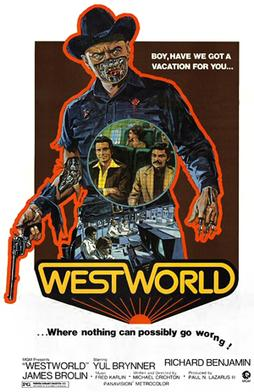
In terms of technological advancement, as with most forms of media this greatly helped with building immersion or even realism, however thrillers benefit more than most other types of media from this immersion, as it makes the audience substantially more prone to being scared/surprised/worried etc. This can be seen through the development of VFX and CGI, as CGI was invented around the 1960’s, for example, the 1973 film “Westworld” was one of the first thrillers to use CGI, this exhibited two different effects of technological advancement, for one, CGI was used to show the world from the antagonists’ (an android) point of view, but technological advancement also inspired the theme of the franchise – that being A.I. robots taking over the world, this theme was entirely created due to worries about technology becoming too powerful and has only become an increasingly common theme for thrillers as time goes on and technology advances. Another example of the uses for technological advancement in thrillers comes from comparing the 1991 “Silence of the lambs” to the more recent 2010 “inception”, although both were received incredibly well (8.6/10 and 8.8/10 IMBD respectively), and both used lots of actual sets, the difference was that inception was able to use even more absurd sets by utilising CGI to hide wires and circuitry that the mind bending sets needed to function, making it appear more seamless and allowing inception to try even bolder methods than ‘silence of the lambs’ ever had an opportunity to do, this highlights that CGI did not entirely overhaul the thriller genre but allowed for subtle yet effective improvements to immersion.
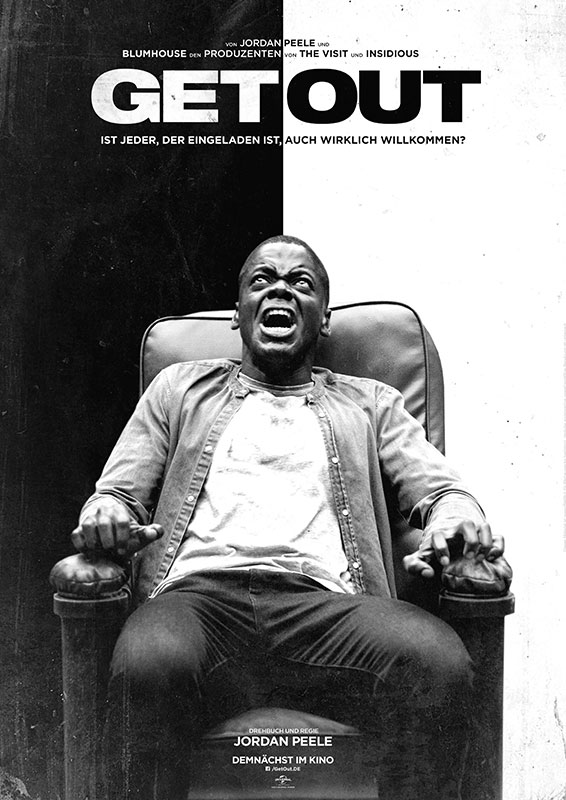
When it comes to change in audience preference, thrillers had very similar trends to most other genres. Firstly, representation became much more prevalent between the time of thriller’s inception and the start of the 21st century, early thriller movies and tv series often starred white men, this does reflect broad cultural trends in the 1960’s as although societal racism had been mostly abolished by movements started by people such as Rosa Parks and Martin Luther King Jr, with American legislation for women’s rights coincidentally being passed at around the same time in 1929, there was still much stigma and racism present in Western countries around people who were seen as foreign races, many had grown up on racist war propaganda from WW1 and later WW2, where white men were often painted as powerful figures standing up for their countries against the “evil” foreigners. This all unsurprisingly lead to a trend of white men being the heroes in thrillers, often having to save a “damsel in distress” who was more often than not a woman, this can even be seen in one of the early thriller series – aptly named – “Thriller” (1960-62), in which almost every single self-contained episode starred a white man, however the prejudice against women would begin to be turned around as time went on, for example the 1996 film “scream” which was a well-received horror-thriller, what made it different was that it actually subverted gender stereotypes by starring a woman who has to save their boyfriend instead of the other way around, it’s positive reception clearly highlights how audiences enjoyed this twist on gender norms, this idea is also supported by Steve Neale’s Genre Theory, where the movie stayed true to the genre in most ways keeping the general audience by being comfortable, but posed a twist (in this case to gender roles) to stay new/fresh and most importantly, bring in a modern audience, allowing the genre of thrillers to stay relevant. Race stereotypes would also begin to be abolished, albeit slightly slower, this can be evidenced by the somewhat recent thriller movie “Get Out” which starred a black lead, the previously mentioned argument for Genre theory also applies to this aspect, overall the biggest impact that audience preferences had on the thriller genre was that of improving representation within the genre, whilst still maintaining foundational narrative elements, broadening the audience of the genre by keeping the older audience as well as appealing to a modern audience.
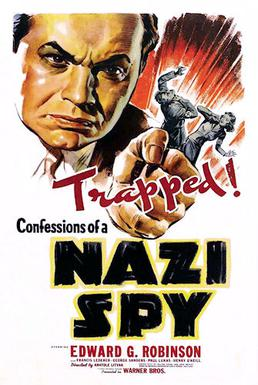
The last facet of the development of the thriller genre is socio-cultural influences. One of the greatest influences on specifically the thriller genre was WW2 (and to a lesser extent WW1,) one of the first thrillers ever televised was called “Confession of a Nazi spy” (1939) which was only the beginning of a long standing trend in thrillers for the coming decades, WW2 was obviously known by all alive on earth at the time and thus it acted as a contemporary theme that the genre of thrillers was very well suited for, this sparked the subgenres of ‘spy’ thrillers as well as ‘war’ thrillers, commentary on wars would continue even in the 1970’s with “Apocalypse Now” portraying the horrors of the Vietnam war at the time, the war thriller subgenre allowed for a more visceral portrayal of war, eliciting anger and sorrow in audiences about the unfortunately accurate portrayal of the horrors of war. However as the world has grown more peaceful (comparatively and objectively) war thrillers have become far less common. Another factor within socio-cultural influences is that of globalisation and politics, in recent years, ideas/cultures have been spreading between different countries and regions rapidly, along with this spread of information, interest in the affairs of other countries has been growing, especially within often sheltered Western countries, this has led to many thrillers being set in countries aside from the USA and Britain, and instead looking at the affairs and issues of other countries, which has of course sparked the popularity of a different subgenre – that being political thrillers, for example, “Red Notice” and “Freezing order” which both explore the questionable Russian government and economy, yet have no reference to war for the most part. Thus socio-cultural influences have dictated the prevalence of specific subgenres within thrillers, leading to a transition from the narrow subgenre of spy/war to more broad subgenres such as political thrillers, and even allowing for the growth of other types of thrillers such as psychological thrillers.
Overall, thrillers have seen extreme development over time, however with the exception of socio-cultural influences, this has not been unique to just the thriller genre. Thrillers have grown in diversity and technical complexity, whilst the themes within thrillers have often been dictated by what is happening across the globe, this allows thrillers to be a useful and ever-contemporary genre, enforcing its position as an audience loved, classic yet relevant genre.
Learning to video edit:
Learning to video edit:
I have already had basic editing experience before doing youtube videos for fun, so I decided that I may as well add editing into my media production repertoire by practicing it!
This practice took place over three main sessions/periods
– The basics at home in my free time
– More complex inclusions during my 3rd preliminary task both at home and at school
– A full day editing workshop at school (hosted by South Sea’s Film and Television school)
This research spanned 15-20 hours (Of active work) and I found it extremely enjoyable!

Firstly,
In my own time I watched the official adobe premiere pro tutorial:
(https://www.youtube.com/watchv=oLMdXC_B1vQ&t=2210s)
Both during and after the video I also recorded and played around with the software using self recorded footage, most of the time I spent practicing in this initial video was simply spent learning the various key binds (surprisingly useful) and cuts the software is capable of, ultimately culminating in a rather basic but still worthwhile clip of me walking down the hallway using various camera angles.
This was also where I first learned to organise clips, sound and sequences into “bins”, a technique which I suspect will become very useful for the naturally more convoluted final film opening!
The short video I created is below!
Secondly,
During my third and final preliminary task (check page for details) we had to make a 1 minute short-short film using the prompt “He’s gone.” During this video I attempted to use every editing technique I had learnt up to this point, introducing major elements such as key-framing, the addition of sound editing, warping speed, lighting/colour grading and even transitions. I believe ALL of these will be used to some extent in my final film opening and can definitely contribute to the camera, sound, mise-en-scène and of course, editing aspects of my final film opening. This video is far more substantial than the last one, both in length and density of editing. Although it is linked on that page, I will put it to the right as well.
Thirdly, my school was able to get a teacher from the South Seas Film and television school to host an Adobe Premiere Pro editing workshop. This spanned the entire day and covered just about everything bar special effects in editing, we ended up compiling a short film using sample footage, (Footage is sourced from ‘Framelines’.)
Here are the key notes I learnt from the workshop
I will very likely use this for my final film opening
The editing process:
– Backup files (!)
– Organise the workflow and files
> I should create a folder for my overall project with subsidiary folders inside for Pre/post production (broken into backup, assets and export) as well as footage (broken into video and audio)
– Project setup
– Ingesting footage (Putting raw footage into editing software)
– Assembly (of the sequence)
– Colour grading
– Title design (How to use the text tool!)
– Export!
Sound:
– Dialogue
– Foley (VFX)
– Ambience (The teacher recommended recording at least a minute of “room tone” for every scene that is visited – a tip which makes complete sense and I will certainly include in my final film opening!)
– Music
Furthermore, we learnt about ideas such as:
– The persistence of time (elongating scenes through the use of parallel editing and cross cutting, allowing for the audience to make links between the shots and build suspense)
– The Kuleshov effect (The idea that the meaning of a shot can be shaped by the shots before or after it)
Analysing film opening conventions:
In class we discussed the common troupes and features of a film
opening so that we can ensure our coursework is made with these conventions in mind, this will allow me to ensure that the opening includes comfortable features that define it’s genre whilst also deviating enough to be unique and engaging –
(Applying Steve Neale’s genre theory)
Film openings generally include:
– Production company logo (Brand representation – self explanatory)
– The title of the movie (Keep in mind typography to ensure it is relevant to the genre)
– A scene setting master or establishing shot
– Introduction of important characters (helps build an audience-character relationship early)
– Foreshadowing (Highly important, as this is what makes the opening relevant to the rest of the movie – effectively a snippet of what is to come)
Film: Baby Driver (2017)
Film: Get Out (2017)
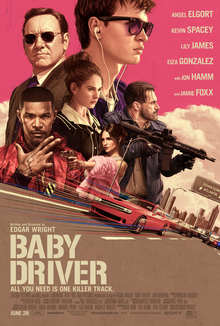
How is the genre of the film made clear in this opening?
Action/crime in the opening the protagonist
– second half of opening has diegetic cop siren sounds often in the background
– protagonist breaks character after seeing cop and looks generally worried – highlights guilt
Horror-thriller Dark, lonely street builds immense sense of
enigma which closely aligns with the horror-thriller genre (this is further established in my analysis below)
What is the target audience of the film and how can you tell this from the opening?
People into charismatic main characters and perhaps crime, the opening spends most of it’s time very clearly establishing what kind of person Baby is, which may appeal to those who enjoy well thought out characters.
People who enjoy traditional horror-thrillers, as the opening does practically everything possible to seem like a typical traditional thriller with the very simple superimposed credits and the cliché lower quality driving through a forest background of the credits which may be an intertextual reference to the opening of the famous horror thriller ‘The Shining.’
What is introduced in the opening? (e.g. characters, themes, setting plot)
The main character “Baby” – shown that he is narcissistic and also has some guilt seeing as he is afraid of the cops
Setting is very lively and takes place in a stereotypical likely American city, however near the end less appealing parts of the setting are shown
A throw away character is introduced and kidnapped.
A glimpse of the antagonist is seen but the face is intentionally cutoff the maximise the enigma, his interesting style of kidnapping is shown as he is practically warning his victims before he even kidnaps them.
Are there any narrative devices used? (e.g. flash backs, nonlinear storytelling, voiceover)
The way the sound changes between the first and second half (before and after the cop encounter) is used to show a worsening in the protagonists mood. Linear.
Follows man walking and getting kidnapped. However there is a time jump between the man getting kidnapped and the forest scene. This makes it ambiguous and non-linear which helps build enigma.
How are micro elements used in the opening to communicate information/contribute to the mood?
Gestures – first half Baby is confident and boisterous, second half he is a lot more shaky and reserved, this difference highlights that he has something to hid from the cops building enigma early on. Soundtrack – A catchy song that reflects his upbeat personality, becomes asynchronous in the second half which also reflects the change to his mood after the cop encounter.
Music in first half has disturbing and almost literal lyrical implications (“Run”,) whilst the second half has almost chant sounding lyrics that are unsettling and somewhat incoherent (may be in another language?.) This allows the opening to further establish the mysterious and unsettling theme of enigma.
How are the credits presented in the opening sequence? What is the visual style of the credits and how does it align with the overall tone?
Credits are superimposed in a prison card Esque font, that fits the crime genre of the movie, colour scheme is orange, black and white which again aligns with the prison and crime related theme.
Universal studios opening (brand recognition)
Blumhouse opening (expectations of horror thriller)
Credits are very simply superimposed onto screen (makes it seem like an older style movie, audience may infer that the movie will follow traditional horror-thriller conventions.)
Give the film opening a rating out of 5 and explain your rating:
The opening is very logical and fun, clearly establishing the charismatic main character Baby, good representation as well, only reason it doesn’t get a five is that I’m not overly into the genre and the credits aren’t done overly well (negotiated reading if you will.)
Conventional and comfortable, establishes the way the killer goes about his kidnappings and is very good at building enigma, the credits do drag slightly though.
★★★★☆ (FOR BOTH)
INSPIRATION:
‘Get Out’ (2017) matched both the genre and to some extent the vibe we wanted our film opening to have, so when we adapted our original storyboard to the new set I thought that the opening could start in a similar way to Get Out. This similar ‘way’ would be a tracking shot showing the focal character walking through a very isolated seeming urban area to build an unsettling ambience, we ended up including this in the final cut! Although there are of course differences, the overall idea was still inspired by Get Out.
Film: The Dark Knight (2008)
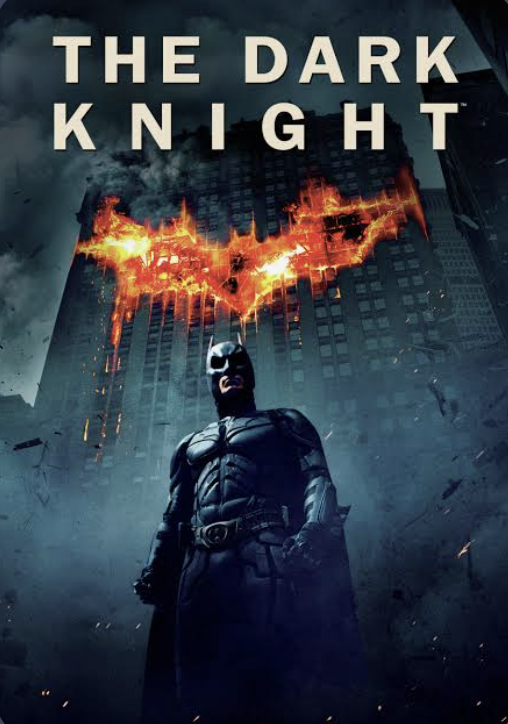
What is the genre of the film and how is this genre shown in the opening?
Superhero, action, psychological thriller.
Superhero is self explanatory as Batman is the main character and the primary binary opposition is ‘good vs evil’ and ‘law vs crime’ , most audiences would go into the opening knowing it is about Batman. The psychological thriller aspect comes from the VERY shadowed and dark themes of the title which is a common convention in this type of movie.
Action – A window is busted open almost immediately and the narrative follows a heist taking place, likely performed by Joker associated individuals (which the audience would be aware of)
What is the target audience of the film and how can you tell this from the opening?
The target audience is likely teen-young adult, the darker themes of the opening immediately establish that this is likely not for kids.
The audience is likely also composed of many who already know about the batman franchise and may enjoy it, or find the idea of a much darker twist than the original comic/cartoon interesting.
What is introduced in the opening? (e.g. characters, themes, setting plot)
Themes –
Dark and dreary, primary colours used are black and cobalt blue, which match batman’s suit.
Jokers henchman with characteristic clown masks are shown committing various crimes but mostly robbing a stereotypical bank.
The setting Is also established with the grey and office like buildings being present. As well as the bank itself.
Are there any narrative devices used? (e.g. flash backs, nonlinear storytelling, voiceover)
Linear. Follows a heist that takes place and the real crimes and consequences that come from this.
How are micro elements used in the opening to communicate information/contribute to the mood?
Drum sounds build tension and establish stakes of the opening.
Makes heavy use of parallel editing to show the various Hijinx and tomfoolery being performed by the jokers diabolical henchman.
Actions of the henchman are relatively goofy by criminal standards which reflects their broken mental states.
How are the credits presented in the opening sequence? What is the visual style of the credits and how does it align with the overall tone?
Stylised dark Warner Bro’s opening (brand recognition and matches the dark realistic theme of the movie)
Credits ditto^
Give the film opening a rating out of 5 and explain your rating:
The acting is very well done and in character, the setting and plot are well established, yet I find the contradiction between the credits and the heist jarring.
★★★☆☆
Researching a production company/logo:
My company of choice : A24
A24 was founded in 2012, they are well known in
recent years for their production of ‘Backrooms‘(2026)
and ‘Everything Everywhere All At Once’ (2022.)
They were founded
by Daniel Katz, David Fenkel, and John Hodges as a
private production studio. They generally help produce
independent films with varying audiences,
although they are not afraid of interesting concepts
(seen in the two aforementioned films above.)
A24 also produces merch, their website having a merch store built in, merch for the Backrooms (their newest release.)
A24 both produces and distributes films. A24 is also valued at $3.5 Billion, which isn’t high in comparison to the bigger competitors but still
very respectable.

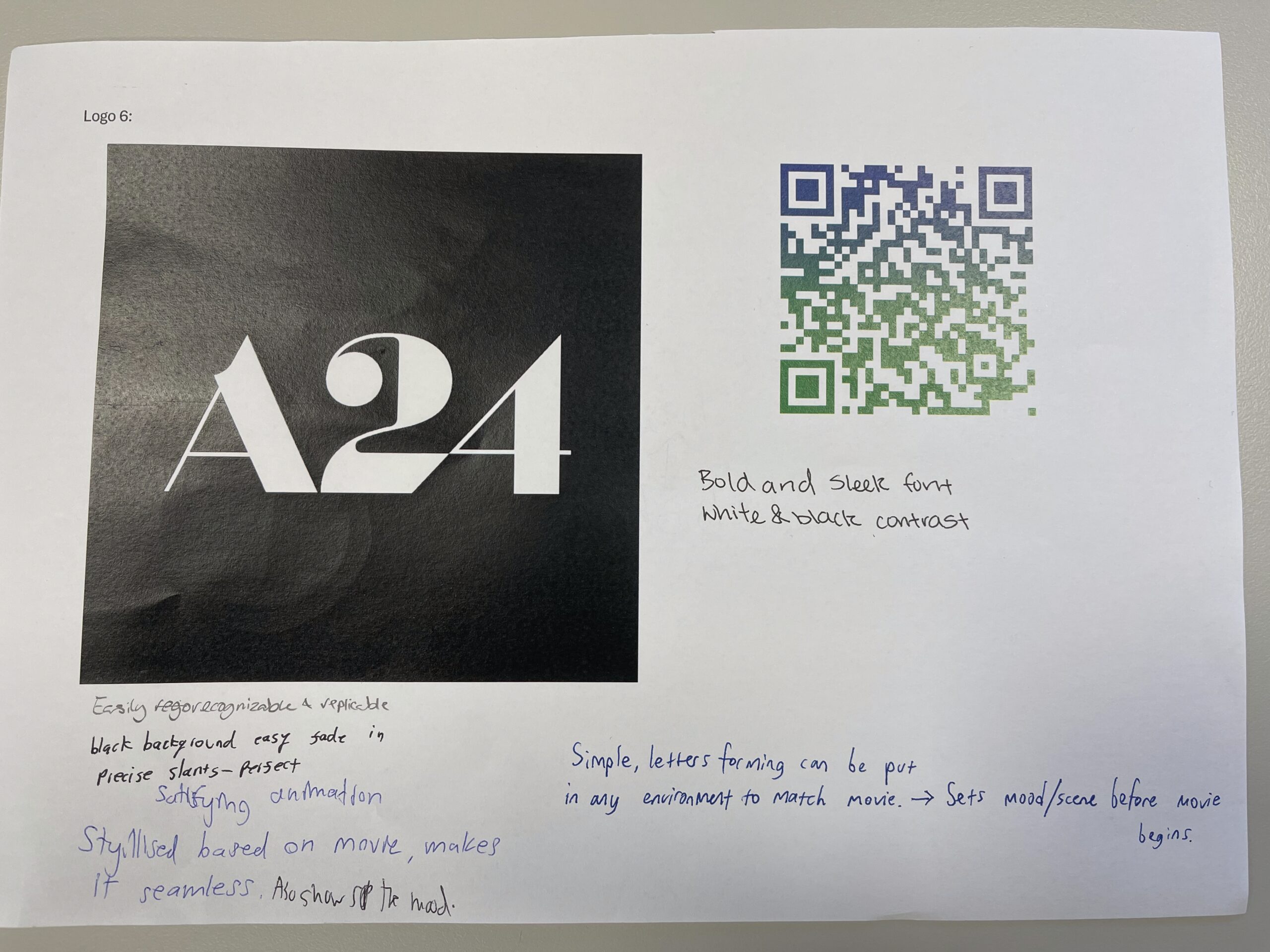
A24’s logo was likely inspired by the motorway (A24 motorway in NA) that the creator used as the name of the company itself. A24 has a simple logo with a modern style custom font. This clearly establishes A24 as a modern staple with the minimalist logo being appealing to modern audiences. In terms of animation the logo is usually seamlessly integrated into the opening of a movie, the colour of the logo and the way in which it fades in changing depending on the footage behind it. This helps prevent the logo from breaking immersion, unlike competitors such as Disney or Paramount, perhaps implying more respect for the often indie creators they help produce cult movies for. The logo hasn’t changed at all since its creation, which makes sense given that it was founded relatively recently, but it also makes it very recognizable unlike other production companies which may confuse audiences when logos inexplicably change.
Inspired by this research
Making the final production logo:
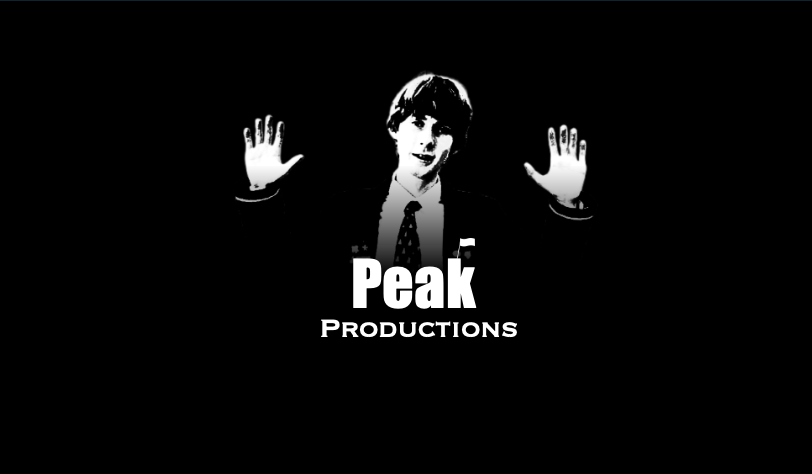
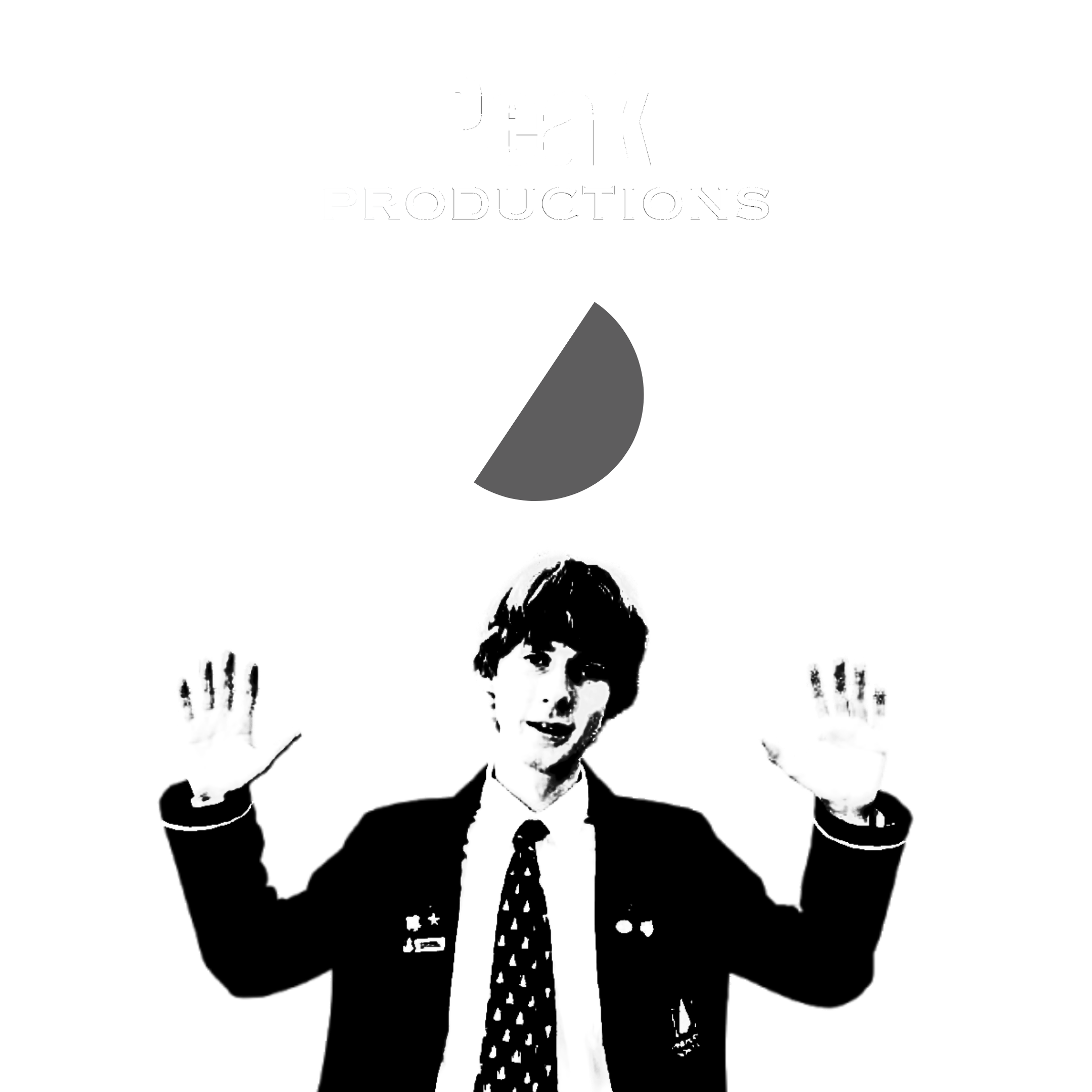
Ultimately, my team used the experience we learnt from analysing the A24 logo, as well as the mystery genre to make this logo.
The name:
To my chagrin my team originally wanted to make the name of our production company “Joel Productions,” (my name is Joel) which I am very opposed to, as it feels unfair to take credit for a group project. After that we decided we wanted a catchy name, so we aimed for alliteration. Eventually we agreed upon the word “Peak” which we settled on, as it rolls off the tongue in combination with productions and implies a level of quality.
The colour:
Next, we knew we wanted the colour scheme to be mystery/horror appropriate, we tried both a red/black and monochrome color scheme. We decided on the monochrome one, as it is simple while still fitting with the horror/mystery genre.
The image:
Fore the image, we took a photo of me with my hands up and made it monochrome, massively exaggerating the shadows, we took some inspiration from the “absolute cinema” joke that modern audiences will likely be aware of, making the logo appropriate for contemporary cinema. The hands appear almost disembodied while the face is obscured, this intends to create an enigmatic atmosphere, which according to feedback from our class, worked out well.