✧ ˚. ˖⋆。 .
Research 1- Genre Essay
Action
With the creation of what is known to be the first ever film shot in 1888, directors have always been experimenting and tweaking their movies to appeal to audiences as much as possible. As the 19th century ended and we saw the beginning of the 20th century, there came the birth of what is largely regarded by historians to be the first action movie; The Great Train Robbery. This film paved the way for the action genre that was later established with its typical conventions in the mid-1900s, leading to many notable titles such as the James Bond franchise (1962-present day), Die Hard (1988-2013), and the Marvel franchise (2008-present day)- the impacts of which are still felt within our society’s film culture today.
Since the first action movie was created, technology has significantly improved as new equipment and software are introduced, leaving behind studios that cannot keep up with the rapid evolution of both audience expectations and development of new tools. Advancements in everyday technology such as AI allows for completely artificially generated scenes and actors, removing the need even for stunt actors. This helps studios reduce costs and put out movies faster than ever before. A notable example of AI being employed would be in Thor: Love And Thunder (2022); Thor attempts to find inner balance but is soon interrupted to stop the extinction of all gods after a galactic threat looms over them- during a sequence a baby version of Thor during a flashback was created via the use of these new softwares trained off of a real baby’s image. This prevents the need to film a real baby and spend many hours trying to get it to act in a desired manner. Before the mass employment of post-production editing via digital means, practical effects would be used to immerse audiences into the scene, such as fake injuries and intense fights done with makeup and harmless props. The pinnacle of an action movie is, however, the high-speed, thrilling sequences that actors had to pull off, often leading to injuries or, in certain cases, death. Nowadays, however, actors can easily avoid having to do or engage in more dangerous situations on set with the help of green screens, rigs, specialised protective gear, and stunt doubles, all of which are attributed to the rapid development of technology over the years to ensure safety in practicality and immersion of the audience.
From the days of live performances in front of an audience to having your audience be on the other side of the screen, preferences have always been changing and evolving to fit the socio-cultural norm. Action movies, while maintaining their key features of exciting stunts and fast-paced sequences, often warp and shape themselves to hold messages that captivate audiences the best. They act as an escape for the average person from their mundane life of school, work, and chores- something to distract from an under stimulating reality. For example, one of the most influential action movies of our time, The Matrix (1999), held the main message of ‘you shape your own reality’. This resonated deeply within the audience- many of whom were just starting to become used to the normalisation of the use of digital technology in the world around them. Its multifaceted interpretations kept audiences talking and the philosophy of its message helped many through difficult times and situations, especially with the next century looming close. In a time of uncertainty, The Matrix took advantage of that and used it as a leverage to not only entertain but to guide people onto the right path. It still stands strong today despite being over two decades old simply because it knew what audiences would be interested in: the new age of technology, and because of this it remains relevant and discussed because of its profound impact on our general society.
Action as a genre is an inherently loose term, and so a motley selection of movies are included under its umbrella. Just to name a few groundbreaking titles that almost everybody knows: Jurassic Park (1993), Texas Chainsaw Massacre (1974), and Jaws (1975). All three are just a glimpse of movies that reshaped the film industry into what it is today as well as the world. Specifically looking at Jaws, it brought to life the horrifying idea of how violent sharks can be. This eventually spread and became so deeply imbedded within our society today that children have to learn that sharks are not at all as dangerous as they are made out to be rather than the other way around. Jaws has also partially contributed to declining shark populations worldwide due to misconceptions by the general public of the risk that they pose to our lives. In 2025, there were approximately 105 shark attacks, 10 of which were fatal. Sharks generally do not attempt to engage with humans unless they have a reason to do so, such as mistaking them for food due to poor eyesight or being provoked. While this is a perfect example of how powerful a film can be, it is also a tale of caution as to how things must be portrayed in media and the effects it can have on the audience consuming said media.
Action movies have reshaped our minds, beliefs, and societies time and time again and they will continue to do so long after the film industry crumbles. The cycle of audiences reflecting changes in the world around us and movies accounting for that to form meaningful connections is one as old as humans, because a society’s form of entertainment is, in a way, a mirror of the society itself.
Bibliography:
https://en.wikipedia.org/wiki/Action_film
https://www.filmsite.org/actionfilms.html
https://www.parrotanalytics.com/insights/the-action-genre-and-its-success-in-modern-films
https://researchguides.dartmouth.edu/filmgenres/actionfilms
https://tvtropes.org/pmwiki/pmwiki.php/Main/ActionGenre
https://www.filmcomment.com/blog/classified-action-cinematography/
https://entertainment.inquirer.net/513830/for-hollywood-stunt-performers-ai-spells-danger
https://filmstories.co.uk/news/ai-14-hollywood-films-that-have-used-artificial-intelligence-and-how/
https://www.pbs.org/newshour/show/how-the-movie-industry-is-adjusting-to-changes-in-viewing-habits
https://en.wikipedia.org/wiki/The_Matrix
https://www.imdb.com/list/ls063192062
https://en.wikipedia.org/wiki/Jaws_(film)
https://www.floridamuseum.ufl.edu/shark-attacks/yearly-worldwide-summary
Research 2- Film Opening Conventions
Films have an almost infinite manners in which they can start, however they typically include a set of conventions that have specific purposes. Here are just a few:
| Production Logo and Film Title | The production logo opens the film giving credit to studios and groups that helped make the film. The film title also appears in the beginning after the production logos, often after the prologue to allude to the movie’s content and to mark the ‘beginning’ of the main events of the story. I will likely use these conventions as a part of my film opening as they both, especially the production logo(s), help to set the tone of a film before it starts and acknowledges who had a part in its creation. |
| Establishing the genre | By establishing the genre of the film the audience knows what to expect in general from conventions typical of those genres as well as helping to ground the film in that genre. I will use this convention for my film, such as enigma for mysteries and setting high stakes for action/thrillers. |
| Character Introduction | The introduction of characters helps the audience to understand the character wholly as a person as well as what their motives and intentions may be. It can also hint at themes of the film that will become more prevalent later on. I will use this convention as most film openings do so to begin establishing the premise as well as to engage audiences for my opening. |
| Topic/Theme | Topics and themes support the message that films are trying to tell the audience, contributing to the overall story and takeaway. This convention is an integral part of any film and its opening. I will definitely use it, as topics and themes that a movie touches on are almost always in the subtext or hidden meanings of openings. |
Common methods of starting a film include an establishing shot, wide shot, exposition, or a short narrative within the overarching narrative of the film. I may use these within my film, but other shots or techniques can work as well if done right.
Research 3- Film Opening Analysis
During class we analysed a multitude of film openings in order to pinpoint key conventions used as well as how the opening engages the audience. Below are my analysis sheets of the film openings:
| Name of Film & Release Date: Baby Driver (2017) | |
| Questions | Answer including clear, specific examples of the text |
| What is the genre of the film and how is this genre shown in the opening? | Action, the main character’s suave nature (which is sometimes a convention of action films) is likely to be a prominent feature later during action sequences. |
| What is the target audience of the film and how can you tell this from the opening? | The film is likely PG-13 or PG and for those who enjoy a more chaotic movie, hence the bustling city, that still keeps a flow, hence the music. |
| What is introduced in the opening? (e.g. characters, themes, setting plot) | Character, setting, some themes |
| Are there any narrative devices used? (e.g. flash backs, nonlinear storytelling, voiceover) | Real-time narrative |
| How are micro elements used in the opening to communicate information/contribute to the mood? | The camera constantly follows the main character in a medium shot in a very smooth manner with little to no cuts while an upbeat diagetic score plays in the character’s earbuds, all whilst everyone in the city continues with their own day which creates a smoothly flowing scene that creates both amusement in the audience and makes the man character feel very suave. |
| How are the credits presented in the opening sequence? What is the visual style of the credits and how does it align with the overall tone? | Credits pop up on screen as the main character breezes through the streets, often at times in sync to the music or actions. Some of them are imbedded within elements of the city, such as graffiti. |
| Give the film opening a rating out of 5 and explain your rating. 4: I enjoyed the music and the flow of the opening scene, though I wish we were told slightly more about what may be to come. | |
While Baby Driver’s opening is great for its genre, its lightheartedness may not be ideal for other genres such as horror, thriller, or mystery.
| Name of Film & Release Date: Get Out (2017) | |
| Questions | Answer including clear, specific examples of the text |
| What is the genre of the film and how is this genre shown in the opening? | Horror, both the introduction of the film production company (Blumhouse) and the dark, empty streets accompanied by the high, unnerving, and hushed music create a sense of uneasiness in the audience. The shot of trees continuously moving past as if in a car which increases the sense of isolation. |
| What is the target audience of the film and how can you tell this from the opening? | Teens and up, children would likely not enjoy a horror movie as it may be distressing to them. |
| What is introduced in the opening? (e.g. characters, themes, setting plot) | Characters, plot, themes |
| Are there any narrative devices used? (e.g. flash backs, nonlinear storytelling, voiceover) | Time jump |
| How are micro elements used in the opening to communicate information/contribute to the mood? | Long shots to enhance the feeling of isolation and despair, set at night to increase fear and anxiety, very little diagetic sound to create tension. |
| How are the credits presented in the opening sequence? What is the visual style of the credits and how does it align with the overall tone? | The credits begin appearing as the kidnapper drives away while the ‘Run rabbit’ music continues to play, continuing into a shot of trees going by while credits for producers and actors fade in and out. |
| Give the film opening a rating out of 5 and explain your rating. 4: It sets the overall tone and atmosphere well and introduces themes. | |
The lighting of Get Out’s opening is very visually compelling and I will draw inspiration from it to use within my own film if required, as the lowkey lighting and contrast it creates is very stark, creating an almost mysterious or eerie atmosphere.
| Name of Film & Release Date: Everything Everywhere All At Once (2022) | |
| Questions | Answer including clear, specific examples of the text |
| What is the genre of the film and how is this genre shown in the opening? | Action/drama/family, the opening shows a typical Asian family’s home environment, Evelyn (The main character) is stressed and has many responsibilities while her husband, Waymond, attempts to ease her stress at the fact that her father will judge the way her life has played out and where she has ended up. Evelyn ends up dismissing Waymond and rushing out and the audience sees in the last shot Waymond looking at divorce papers. This unhappy equilibrium contrasts to the opening shot where we see the family happy and together, smiling in the mirror. |
| What is the target audience of the film and how can you tell this from the opening? | (Asian) teens (whose parents immigrated to find a better life elsewhere) and up, the dynamics, language they are speaking, and overall characters are all familiar to this demographic as it is what they likely would see it reflected at home as well. |
| What is introduced in the opening? (e.g. characters, themes, setting plot) | Characters, themes, setting, parts of the plot |
| Are there any narrative devices used? (e.g. flash backs, nonlinear storytelling, voiceover) | Flash back |
| How are micro elements used in the opening to communicate information/contribute to the mood? | The opening shot is dark but has a blue light, emulating an unnatural lighting which contrasts with the ‘present day’ household which has a muted, warm yellow light throughout the house. These colours may represent the stability of the household, with it being not as stable yet happy and fun in the past but stale yet monotonous in the present. |
| How are the credits presented in the opening sequence? What is the visual style of the credits and how does it align with the overall tone? | As the film company is shown in the start, the presentation switches between many different kinds of fonts and formats which reflects the themes of the multiverse and different timelines. It also foreshadows the later chaotic nature of the movie. |
| Give the film opening a rating out of 5 and explain your rating. 5: It sets the scene and shows the audience Evelyn and Waymond’s relationship as a setup for what happens later in the movie as well as being deeply relatable to myself. | |
Everything Everywhere All At Once begins with a flashback that establishes the relationships of the family first and foremost, contrasting happier, carefree times with the struggle and stress of the movie’s present day. I may draw inspiration from this nonlinear narrative if required for dramatisation and context.
Research 4- Coursework Inspiration
– Groundhog Day (1993) directed by Harold Ramis, romantic/comedy
– Upon waking up to the same day, the clock is shown turning to 6:00 am.
– We chose this aspect of the movie because it reflects our similar concept of reliving the same day and showing the clock helps to convey the message of time having turned back and the main character is back at square one.
– The closed frame of the close up on the clock forces the audience to recognise that the day has reset, becoming a symbol of a new start throughout the film and making each repeated day all the more impactful as the audience is also familiarised with the room.
– The radio in the background acts almost as an anchor everyday, confirming immediately that the day has repeated as we hear it saying the same script. It also adds an element of lightheartedness initially that quickly becomes old and tired.
– Run Lola Run (1998) directed by Tom Tykwer, action/thriller
– In Run Lola Run, the film is split into 3 distinct parts, all being the same day but with different outcomes.
– We took inspiration from this format as we also wanted to show our film’s repetition of the same day and the different methods that our main character, Blair, tries to escape it.
– This disrupted continuity helps to convey our plot of turning back in time, though this is different to Run Lola Run’s nonlinear narrative, as ours follows Blair which, to her, the events of our film are all linear and happening to her.
– In The Tall Grass (2019) directed by Vincenvo Natali, horror/drama
– In The Tall Grass creates a sense of disorientation and insanity throughout as we watch the characters fight to stay alive, find each other, and try to escape. It prioritises its horror elements, however, which, while pertinent in our film, is not what we want to focus on.
– Instead, we wanted our own character to slowly feel like they are going insane through the repeated days and to create a similar feeling of hopelessness and confusion.
– Through this disorientation of the audience, it connects them to Blair and her slow collapse of reality as she desperately tries to prevent her friend’s death.
Research 5- Production Companies and Logo Research
Full name of the company and founded date
- A24, August 20th, 2012, Daniel Katz, David Fenkel, John Hodges, Manhattan, New York City
Current parent company (if there is one)
- None, A24 is an indie company.
What types of films does this company usually produce and how does their logo reflect their typical target audience?
- Indie films with an emphasis on how the director wants to tell their story. Target audience is typically Millenials and Gen Zs as this audience is open and even wanting for more unique movies atypical of industry standards.
Revenue for past financial year
- While A24 is a private company and therefore does not publicly show their finances, some estimate up to $300 million a year could be earnt.
Do they also distribute their films? If not, who do they typically work with for distribution
- A24 distributes their own films.
Recent successes/achievements and challenges/controversies
- A24 recently released ‘The Backrooms’ which has gone on to be their highest earning movie, placing in the top 3 movies today. However, A24 has faced several controversies mostly pertaining to the content of certain movies and the usage of AI within their marketing.
Meaning behind/intention of the logo
- The name A24 was inspired by the Italian A24 motorway when Daniel Katz was driving on it.
How the logo has changed over time and why it has changed.
- The logo has not changed significantly since the company’s founding.
Below are some of our analysis of the A24 logo that we had done in class:
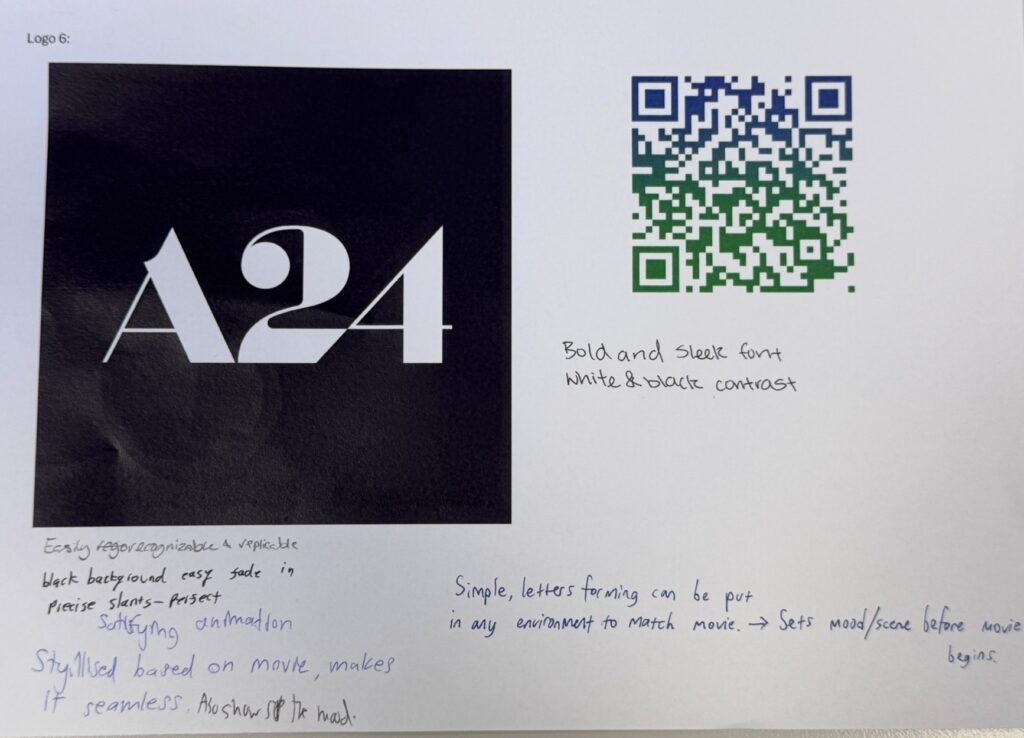
We chose to draw inspiration from A24’s simple yet bold logo, contrasting blacks and whites against each other. The simplicity would also mean that it would be easier to animate into a simple but effective production company logo.
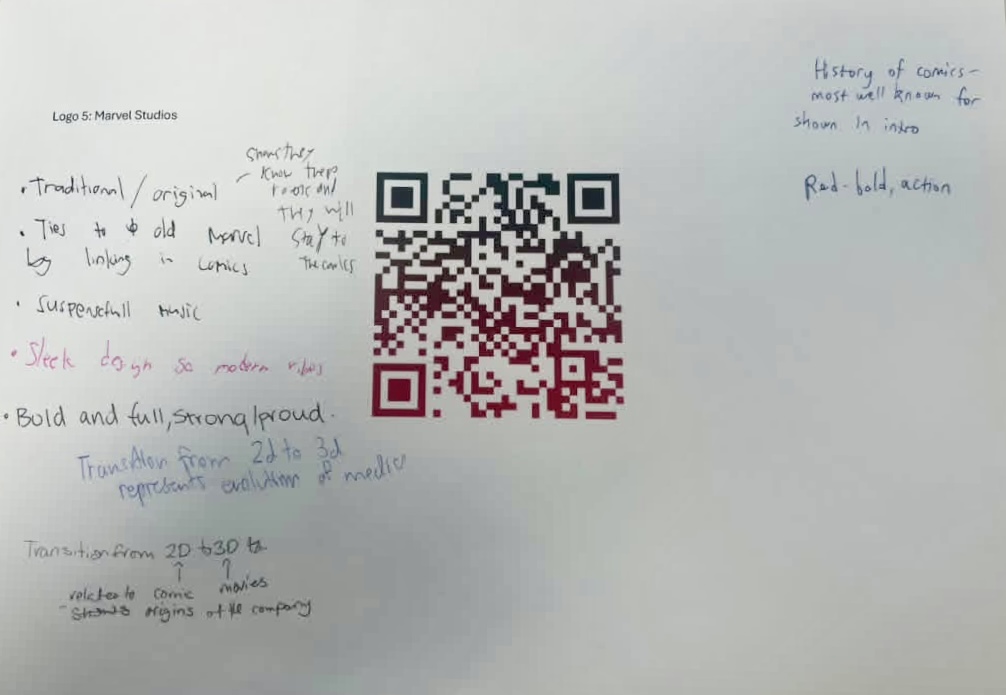
Below are some more of production company logo analysis that we had done in class, this time with Marvel Studios’ animated logo.